


 Located directly opposite CHARING CROSS TRAIN STATION at: Room 102, 8 Duncannon Street, WC2N 4JF, London, United Kingdom
How Long Does It Take to Get a UK Apostille? Timescales Explained
Posted on 21st September 2026One of the most common questions people ask before starting the apostille process is simply: how long will this take? Whether you have an urgent visa application, a property transaction abroad, or an overseas employment contract waiting on your documents, the answer matters enormously. The good news is that the UK now offers several routes — from next-working-day FCDO processing to electronic apostilles — and understanding each one helps you plan with confidence.
What Determines How Long a UK Apostille Takes?
The apostille itself is issued by the Foreign, Commonwealth & Development Office (FCDO), which is the designated competent authority for England, Wales, and Scotland under the Hague Apostille Convention of 1961. However, the overall time from start to finish depends on more than just the FCDO’s own processing speed. There are typically three stages to consider:
- Stage 1 — Notarisation or certification (if required): Many documents need to be signed or certified by a UK notary public or solicitor before the FCDO will apostille them. Arranging a notarial appointment adds time before the document even reaches the FCDO.
- Stage 2 — FCDO processing: Once the document is in the correct form, the FCDO attaches the apostille certificate. This is the stage where your chosen service tier (standard, priority, or e-apostille) determines turnaround.
- Stage 3 — Return delivery: If you are using a postal or courier service rather than walking in, you need to factor in return postage time on top of the FCDO’s processing window.
Delays most commonly arise at Stage 1 — either because a document was submitted to the FCDO in a form it cannot accept, or because notarisation was not arranged in time. Understanding which documents need prior notarisation (and which do not) is therefore just as important as choosing the right service tier.
What Are the Different FCDO Service Tiers and Their Timescales?
The FCDO currently offers two main processing routes for apostilles on UK public documents, as described on gov.uk:
Standard (Postal) Service
The FCDO’s standard postal service is the most widely used route for individuals sending documents by post. As of the time of writing, the FCDO asks applicants to allow several weeks for processing under the standard service, and actual turnaround can vary depending on current demand. Gov.uk publishes current estimated waiting times, and it is always worth checking the live guidance before submitting, as timescales do change. If your deadline is firm, the standard postal service is generally not recommended unless you have ample lead time.
Next-Working-Day (Premium) Service
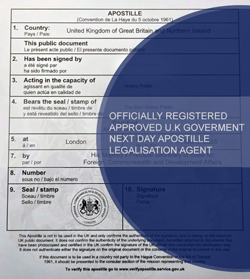
For urgent requirements, the FCDO offers a next-working-day apostille service for eligible documents submitted through an approved channel. This is where using a professional apostille agent becomes particularly valuable: agents with an established FCDO account can lodge documents directly and collect the apostilled document the following working day, removing postal uncertainty from the equation entirely. Apostille Direct London offers this next-working-day FCDO service for eligible documents, which can be critical when a foreign institution has set a hard deadline.
E-Apostille Service
The UK launched its electronic apostille (e-apostille) service in line with the HCCH’s e-APP (Electronic Apostille Programme). Rather than a paper certificate physically attached to your document, an e-apostille is issued digitally and can be verified online through the FCDO’s register. E-apostilles are increasingly accepted by foreign authorities, particularly in countries that have adopted the HCCH e-APP framework, but you should always confirm with the receiving institution that it will accept an e-apostille before opting for this route. Where accepted, e-apostilles eliminate postal delays entirely and can be delivered much faster than paper equivalents.
Which Documents Need Notarisation Before Apostille — and How Does That Affect Timing?
Not every document needs to go via a notary public before reaching the FCDO. The distinction is important for planning your timeline accurately.
Documents that typically do NOT require prior notarisation include:
- UK birth, marriage, death, and civil partnership certificates issued by the General Register Office (GRO) or a local register office — these are already public documents bearing an official signature or seal.
- Certificates of good standing or company documents issued directly by Companies House.
- Criminal record certificates (DBS certificates) issued by the Disclosure and Barring Service.
- Court orders and judgments sealed by HM Courts & Tribunals Service.
Documents that typically DO require notarisation or certification first include:
- Privately drafted documents such as powers of attorney, statutory declarations, or affidavits — these carry no official signature the FCDO can verify until a notary public or solicitor certifies them.
- Educational certificates and degree transcripts — the FCDO generally requires these to be certified by a notary public or, in some cases, by the issuing institution in a specific way before apostille is possible.
- Company documents such as board resolutions or articles of association that are not Companies House records.
- Certified copies of original documents where the copy itself needs to be what is apostilled.
If your document falls into the second category, you should book a notarial appointment before submitting to the FCDO. Combining a same-day or next-day notarial appointment with the FCDO’s next-working-day service is often the fastest realistic end-to-end route for privately drafted documents.
What Can Cause Unexpected Delays — and How Do You Avoid Them?
Even when you have chosen the fastest available service tier, certain common mistakes can push the process back significantly. Being aware of these in advance can save days or even weeks.
- Submitting a document in the wrong format: The FCDO will return documents it cannot apostille. For example, a photocopy of a birth certificate submitted instead of the original, or an educational certificate certified by a solicitor when the destination country insists on notarial certification, will be rejected or queried.
- Not checking whether the destination country accepts apostilles at all: The Hague Apostille Convention only applies between member states. If the country you are sending the document to is not a Hague Convention member, an apostille will not be sufficient — full legalisation through the destination country’s embassy is required instead. This is a separate, longer process and should be identified before any work begins.
- Using a GRO certificate that is out of date in the recipient country’s view: Some foreign authorities (particularly in legal and immigration contexts) specify that vital record certificates must have been issued within a certain period. If your birth certificate was registered decades ago but the foreign authority wants a recently re-issued copy, you may need to obtain a new certificate from the GRO before the apostille process can begin.
- Missing the FCDO’s cut-off times for same-day lodgement: If you are using an agent to lodge documents with the FCDO for next-working-day turnaround, there will be a cut-off time for lodgement on any given day. Missing it by even a short time means the clock starts the following working day.
- Public holidays: Both UK bank holidays and, in some cases, holidays at the destination country’s embassy (if full legalisation is also needed) interrupt processing. Always count working days, not calendar days.
What Is a Realistic End-to-End Timeline for Common Scenarios?
To make these timescales tangible, it helps to think in terms of specific document types and service combinations. The following are illustrative general timelines based on the process as it works at the time of writing — always verify current FCDO timescales on gov.uk before relying on them for a firm deadline.
Scenario A — UK birth certificate, next-working-day FCDO service, collection in person: If the certificate is already in hand and is an original GRO-issued certificate, a professional agent can lodge it with the FCDO and have the apostilled document available for collection the following working day. End-to-end: as little as one to two working days when using an agent with direct FCDO access.
Scenario B — University degree certificate requiring notarisation, then next-working-day FCDO: Day 1: notarial appointment and certification. Day 2: lodgement with FCDO. Day 3: apostilled document ready. End-to-end: approximately two to three working days in straightforward cases, assuming no queries arise.
Scenario C — Standard postal service, no notarisation required: Posting the document to the FCDO, waiting for current standard processing times (check gov.uk for the live figure), then waiting for return postage. End-to-end: several weeks in many cases, depending on current demand.
Scenario D — Full embassy legalisation required (non-Hague country): Notarisation, then FCDO apostille (if required by the embassy chain), then submission to the relevant embassy in London. Embassy processing times vary widely by country and are entirely outside the FCDO’s control. End-to-end: anywhere from one week to several weeks or more, and early planning is essential.
If you are working to a fixed deadline set by a foreign authority, institution, or court, always work backwards from that date and add a buffer. Document legalisation processes involve multiple organisations, and even the fastest professional service cannot control every variable.
Need Your UK Apostille Quickly?
Apostille Direct London offers FCDO next-working-day apostille services and e-apostille processing for eligible documents, with walk-in appointments available Monday to Friday, 9:00am to 6:30pm. The office is located at Room 102, Golden Cross House, 8 Duncannon Street, Westminster, London WC2N 4JF — directly opposite Charing Cross Station. You can also call 0203 297 8766 to discuss your document and the fastest available route before committing to a service. Whether you have a single certificate or a bundle of documents for an overseas transaction, getting clear advice on timescales at the outset is always the best first step.
Posted in Notarial Blog